Saturday, January 3, 2009

Merry Christmas


If an old guy like Santa can do shiko dachi, so can you. ;)

Thursday, December 11, 2008

Karate to Wrestling

We have moved, and alas are no longer training under Sensei Lichtenheld. There is a nearby karate "school" called "PowerKix."' Something in the name tells me it is likely not traditional, probably not karate, and something more akin to babysitting.

While I am currently only walking the path of employment, my two sons are now in a wrestling program. It has good discipline, good physical excercise, and good fighting skills for real-world fights. However, it lacks the spiritual path, the place of the path, and a true sensei. Alas, they are few and far between in this world. I hope everyone interested in true karate in the Tucson or Guadalajara areas will check out the local Rissiyokai school, and stick with it for at least 2 months.

Tuesday, September 9, 2008

Excerpts from my written journal

We will soon be moving away from Tucson, and thus from the most excellent training of Sensei Lichtenheld. As we have been packing things up, I came across my Journal from the time when Chris and I first went to Goju Ryu at the Lighthouse YMCA. Here are excerpts from a few entries when we started that may be interesting.

March 19, 2005, Saturday:
I woke up with a sore throat, and it was raining. We went to the YMCA where Chris and I did the Karate class. It was pretty rigorous and pretty intense. ...
March 26, 2005, Saturday:
Chris and I did Karate. It was a little easier than the first time. It seems to be a very exact style. ...

April 9, 2005, Saturday:
We went to Karate in the morning. The Sensei wants us to test for white belts in May. .... (While I wrote white, that just shows what a newbie I was.)

April 16, 2005, Saturday:
Went to Karate in the morning. Stayed after to work on skills and learn a kata. ...

June 4, 2005, Saturday:
It was the morning of the yellow-belt test. We purchased uniforms, but it was deemed better to wait until later so we would not trip on our uniforms. The test went well for pretty much everyone. Even the kid who couldn't tell directions did OK. Everyone was really happy afterward. ...
It was really fun to look back and read some of those entries. I've learned so much by studying karate for the past ~3.5 years. I am very fortunate.

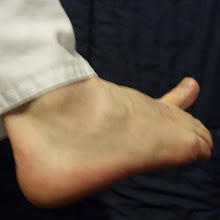
My sensei has suggested we write down notes after class. I started this blog in part because of that. However, I think it is important to document our own personal journey on the Do. It is something that applies both to karate and to our life.

P. S. Another paper I found was a list of "Lifetime Goals." One of those was to earn a black belt. ;)

We are now Brown Belts!

Today, Chris and I received our BROWN BELTS. Achieving it was an amazing feeling. It really means something to get a brown belt in a tough, traditional style. I am very happy to have made it this far.

What a day!

Monday, September 8, 2008

Rissyokai geneology

I borrowed a book from my Sensei. It had a karate "geneology," for which I extended below.

From "Traditional Karatedo, Okinawa Goju Ryu, 1 Fundamental Techniques" by Morio Higaonna

  1. Ryo Ryuko
  2. Higaonna Kanryo (1853-1916)
  3. Miyage Chojun (1888-1953)
  4. Kina Seiko (1911- )
  5. (Kawasaki-shi) Izumigawa Kanki
  6. Harada Hyotaro (died 1998 at 71)
  7. Susumu Umezawa
  8. Eric Lichtenheld

Saturday, May 31, 2008

Notes on Kata from Today

In Kobo Sandan:
  • The secret is in the pull. Think of the body movement on the blocks as a wave. The pull is a vital part of that wave.
  • On the double block portion, pause slightly for the "Kodak Moment." Speed it up only after you get the hands correct doing it slowly.
In Saifa:
  • The double block at the end not only protects from a simultaneous punch and kick, but also turns the attacker upside-down.
  • On the knee-then-kick, turn your head to the right, then the left
In Seiyunchin:
  • There doesn't appear to be an obvious answer to slapping the hand on the elbow.
  • On the "bend over" grab defense try to make front and rear hands straight lines, and extend them out as far as you can.
We have really, really got to practice to be ready for the Brown Belt exam. Wish us luck!

Link for today:

This is where the sensei trained in Guadalajara, Mexico, as well as their website and some pictures.

Sunday, March 2, 2008

More Detail on Seiyunchin

Overview
  1. A set of three shiko daches, with grab defenses.
  2. Bend down and lift opponents leg while stepping back with front foot into something like Renoji dachi (The letter L stance). Right hand will be in a fist, left hand in a prayer.
  3. Punch with right, and step forward with both feet.
  4. Use left hand to strip right arm while stepping back.
  5. Right elbow up, left hand to right elbow.
  6. Two handed block to the right, feet in check stance with right foot NE.
  7. Shiko with gedan, toward NE and back.
  8. Left foot slides into "check stance," left foot NE
  9. Two handed block and shiko combo towards the NW.
  10. Archer stance with the front of the body facing west. Need to keep low on the transition to archer stance. Left arm covers head, right arm covers body. Pull left arm across face while flipping hand over.
  11. Archer stance with the front of the body facing East, so the back arm is right. Keep the right elbow in tight while pulling it back. Left hand covers along lower level.
  12. Foot sweep with right foot, followed by two uraken with right hand.
  13. Left arm down, with the fist covering the knot. Right elbow down, but right hand up.
  14. Turn, and tighten body while blocking up with left, and down with right.
  15. Uppercut-Shiko combo to the SW: left hand covers head, palm out. Step into zenkutsu dachi with right leg forward. Short uppercut (make sure not to scoop it) as you drop into shiko. Uraken forward, then shiko backwards with defensive uraken.
  16. Facing N, double grab sequence of stepping back and stripping off arm.
  17. Same sequence as 13-16, but with the shikos to the SE, and hands reversed.
  18. Strip hand and uraken.
  19. Grab defense with hands ending in Mt. Fuji position.
  20. End and bow.

Other Notes
  • Turn and pop, then cover your head as you step into zenkutsu. Lock in zenkutsu, pausing briefly. Then, shiko and uppercut while dropping the hand covering the head to the solar plexus. After another brief pause, do uraken forward then back.
  • Breathing on the first three shikos:
    1. Breath in while up.
    2. Breath out while going down.
    3. The palms are up on all but the last hand movement.
    4. Pause between grabbing the hands and jabbing the ribs.
  • The two-handed blocks require moving the hips.
  • On all shiko movements, and transitions from one shiko to another, keep low.
Here are a couple of good references for terminology:
http://www.lyon-karate.com/karate_terms_glossary.php
http://www.cope.co.za/karate/terms.htm

Here is a good reference on stances with pictures.
http://www.geocities.com/sadenoo2/stances.html